
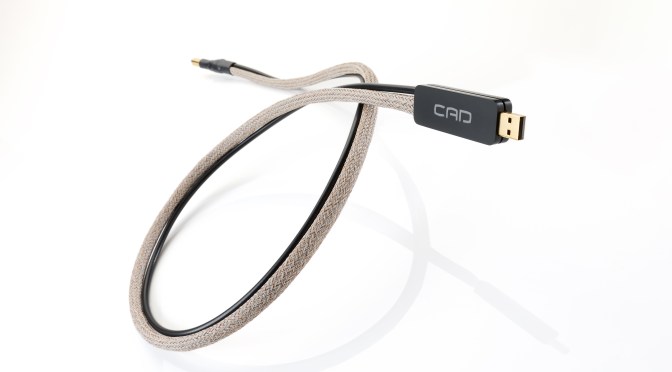
There’s a common assumption that digital audio sent over a USB cable is bit-perfect, writes Andrew Harrison, leading to “a naïve way of viewing the value of specialised USB wiring.” The reality, however, is that “unlike the protocols used for transferring file system data, the USB audio standard has no robust error checking and correction.” Which is why a digital audio system has much to gain from advancements such as CAD’s USB II-R USB cable.
“An identical USB cable can serve to connect your scanner, hard drive, mouse or DAC; but quite different comms protocols are used by different devices,” explains Harrison. And, in the case of audio, there’s no guarantee of perfect transmission of the bits.”
Harrison expounds a clear argument for seeking a certain level of quality in our USB cables. However, that’s not to say that your investment in a better alternative will necessarily pay off, since many of the USB cables made for audio “may be marketed as being built to exacting standards, but they rarely step outside of industry specifications”.
Fortunately, there’s a notable exception: Computer Audio Design (CAD) has consistently “challenged the state of the art, applying sound electrical engineering to make a demonstrably better connection for audio than a simple standards-compliant USB 2.0 wire”.
The company’s new USB II-R is the latest version, and Harrison unpacks in some detail “what sets the CAD USB cable (now a patented invention) apart”, resulting in “easily the most ‘analogue’ sounding of them all, erasing the tiniest hints of what we think of as ‘digital’”.
“The difference… must be heard to be believed. Against any known contender, this winner takes them all. ”
 View / download Andrew Harrison’s review in full. published in the March 2023 issue of Hi-Fi Plus.
Find out more and track down your nearest retailer at www.computeraudiodesign.com
 David Denyer PR | The hi-fi specialist